Friday, January 14, 2022

Minneapolis Should Open the Protected Bike Lanes on Blaisdell Avenue


Many people were excited to see the new concrete-protected bike lanes being installed on Blaisdell Avenue South between 28th Street and 32nd Street this past fall as part of the Whittier-Lyndale bikeway project. 

Unfortunately, delays have plagued this project. Public Works initially committed to delivering the entire length of lanes during the 2021 construction season. The department got off to a late start, however, and ended up splitting the project into two phases to be delivered across 2021 and 2022. People who have been advocating for a safe way to bicycle between south Minneapolis and downtown since 2018 were understandably frustrated by that delay, but it was understandable given the pandemic.

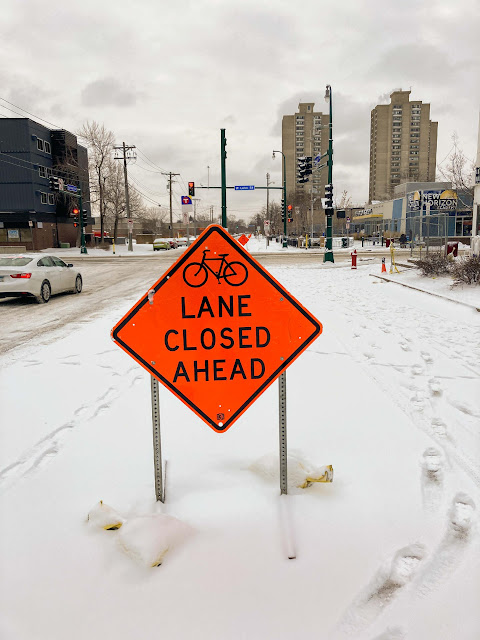
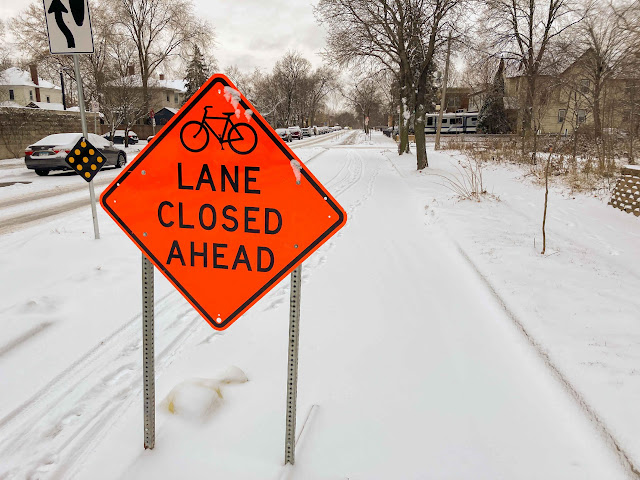
What’s not understandable is Public Works’ rationale for never opening up the newly concrete-protected bike lanes between 28th and 32nd streets, and instead forcing bicyclists to ride in a car-traffic lane for four blocks. This has been happening since October 1, 2021.

Blaisdell Closed1467.jpg

This decision directly conflicts with the updated Complete Streets Policy that the City Council adopted in late 2021. That policy states that during street construction: 

Impacts to pedestrians, bicyclists and transit users will be limited to the extent possible during construction. Safe, convenient, and connected detours will be established for people as they walk, take transit, and bicycle when those networks are temporarily interrupted by construction work.

2021-12-23_15-10-13.png

The Public Works representative responsible for closing this section of bike lane has stated that they cannot open it until the weather warms up enough to fully paint the stripes for the bike lanes between 28th and 32nd streets. Otherwise, automobile drivers might become confused and drive in the protected bike lanes.

Here’s what this Public Works staffer couldn’t answer: How does the absence of green paint in this concrete-protected bike lane make it more dangerous to my safety than the alternative — me having to bike in an automobile traffic lane with my children?

This same Public Works staffer suggested that if bicyclists don’t want to ride in the car traffic lane on Blaisdell, they can simply take an alternative protected bike route. But no other protected bike route exists between south Minneapolis and downtown, a fact this Public Works staffer was surprised to learn.

In the near term: Public Works should open this portion of the Whittier-Lyndale bikeway and plow it for the rest of the winter. A solution that temporarily keeps drivers out of the concrete-protected bike lane does not necessarily require green paint to be applied to the asphalt. Since I am neither a trained traffic engineer nor a lawyer, however, I can’t say which solutions would prevent the city from being found liable if a car driver mistakenly drove down this bike lane and struck a bicyclist.

In the long term: Public Works needs to put vulnerable road users first on Minneapolis streets — and follow its Complete Streets Policy every time it performs work on sidewalks, crosswalks or bike lanes. 

Telling my family and friends that we should just take another route does not comply with Complete Streets and seems to value easy solutions for city staffers more than the lives of people who use city infrastructure in multimodal ways.

Want to Take Action to Fix This Problem?

Email your City Councilmember and the staff associated with this project. Let them know that you’re counting on them to keep you safe on our streets year-round and to hold staff accountable to following city policy.

  • Ryan Gottsleben, paving engineer, Minneapolis Public Works: Email Ryan.Gottsleben@minneapolismn.gov or call 612-590-4233 (mobile).
  • Larry Matsumoto, paving engineer, Minneapolis Public Works: Email Larry.Matsumoto@minneapolismn.gov or call 612-919-1148 (mobile).
  • Find your City Councilmember.

Blaisdell Closed1480.jpg

Note: this post was originally published at: https://streets.mn/2022/01/14/open-protected-bike-lanes-on-blaisdell/

Wednesday, August 21, 2019

New Bollard Day for 26th Street!

The Our Streets Downtown Protected Bikeways work group would like to thank the City of Minneapolis Public Works employees that recently restored the bollards to 26th Street!

Up until a week ago, there were only thirteen plastic bollards designating the bike lane on 26th Street between Blaisdell and Lyndale as protected. On the eight block stretch of 26th Street between Lyndale and Hennepin, there was just a single bollard. Most of the missing bollards were accidentally taken out by last winter’s snowplowing, and had been missing since February. Many of our work group members had stopped riding on 26th Street as a result – 26th Street just didn’t feel protected at all any more.

We’d love to see something stronger, and more permanent installed on the 26th Street corridor. We aren’t engineers, but this BikeRail product seems like it would do a much better job of keeping cars from drifting into the bike lane, and potentially harming cyclists. In the meantime, we are happy that the plastic bollards are back.

Check out the “Before” and “After” photos below. Which street layout do you prefer? Would you like to see more permanent infrastructure here? Let us know in the comments, or on Twitter.

Before:

1

After:

2 

Note: this post was originally published at: https://www.ourstreetsmpls.org/new_bollard_day_26th_street and https://streets.mn/2019/02/20/municipal-sidewalk-clearing-in-richfield-an-interview/

Wednesday, February 20, 2019

Municipal Sidewalk Clearing in Richfield: An Interview


Sheridan Ave And 73rd St

A municipally-cleared sidewalk at Sheridan Ave and 73rd St in Richfield, MN.

Having clear sidewalks in the winter is an important issue for a lot of people. People should be able to move around their city or town year-round, and they shouldn’t have to use cars in order to get around easily. For my family, we need clear sidewalks in order to walk to the library and stores while using our stroller to carry small children. For some of my neighbors, they need clear sidewalks so that they don’t slip, fall, and end up in the hospital. For a few of my neighbors, they need clear sidewalks so that they can use their wheelchair to roll to the bus stop. For all of these reasons, I have been curious about alternatives to having property owners shovel their own sidewalks. When I heard that the city of Richfield, which is a suburb just south of Minneapolis, provides municipal sidewalk clearing, I wanted to learn more about their program. I didn’t find any information about it online, so I called Richfield’s Public Works department, and they put me in touch with Chris Link. What follows is my conversation with Chris, which has been edited and condensed for clarity.

Who are you, and what do you do?
My name is Chris Link. I’m the Operations Superintendent for the city of Richfield Public Works. It’s my overall responsibility for snow removal procedures and policies for streets, sidewalks, trails, everything.

For context, how does Richfield Public Works handle snow events, in general?
We treat every storm differently. It’s basically, when will it stop, or slow down? Today for example, it started snowing in the middle of the night, the forecast said that we’d have about two inches at five o’clock in the morning, but there was a lot more than that. So we said, we’re going to have our crew that clears our main roads come in at 5:00, we’ll do one run of our main roads, and then we’ll see what the storm is doing. So today we had ten guys start at 5:00, and now everyone’s going to go out at 9:30. The snowfall on Sunday ended at 1am, so we went out at 1:00 and plowed until 10:00, and then went home. We have to really balance it, we don’t want to wear the guys out. When they’re tired, that’s when accidents can happen. We don’t do split shifts, we use all available staff.

Do Richfield residents have to shovel their sidewalks at all?
No. It’s not required, there isn’t an ordinance that says they have to. I’ve worked for Richfield for twenty years, and ever since before I started, we’ve had equipment to clear the sidewalks.

How many miles of sidewalks does Richfield clear?
It’s roughly forty-six miles. 66th Street’s [separated cycle track is] brand new, so we’ll have updated numbers this summer.

How many miles of streets does Richfield clear?
124 miles, and with a 4” snowfall, that will take us six to eight hours to clear.

(For reference, Minneapolis currently has 1,715 miles of sidewalk and 1,081 miles of streets according to the Minneapolis Pedestrian Masterplan.)

How long does it take Public Works to get all of the sidewalks cleared?
Now [because of our new equipment] we can get through sidewalks in about eight hours. It’s getting more difficult with the amount of snow [this February]. We’re going to have to start hauling some of the snow away.

Do you know approximately how much the service costs per resident?
We don’t assess separately, it’s just a service that Richfield provides through taxes. We’ve never calculated the cost. If I start spit-balling, the capital costs for the vehicles, we probably have close to a half million dollars in equipment for just sidewalks. And then there’s our time, but I have a difficult time adding cost to city services, because when you talk about staff time, they are going to be here working no matter what. It’s just [because it’s snowing] today they’re going to be plowing snow. In two weeks, they could be doing trees, changing water meters, fixing water main breaks, they’re always going to be here.

Washburn Ave And 75th St

Municipally-cleared sidewalks at Washburn Ave and 75th St in Richfield, MN.

Are residents generally happy with the service?
Yes. We do have our problem areas though where, “It’s not cleared on time and I’ve got to get to the bus,” we get those kind of calls, but I assume that they’d much rather have us do it than them. We aren’t perfect though. Sometimes it is difficult for people in wheelchairs to get through our sidewalks. We aren’t perfect, and I know that.

What are some other comments that you hear from residents?
The hard part with sidewalks now is ice events. We don’t [treat] sidewalks after ice events. That’s the part that we’re working through right now. These [winter] rain events that we’re getting are more frequent. When I started, it wasn’t an issue. The last four years, it has been. We’ve had one ice event per year. On streets we can kind of take care of it. The last one we had was terrible. With sidewalks we didn’t put any salt out, we didn’t put any sand out. There are environmental concerns, and there’s budgetary concerns with that. If we start putting salt on sidewalks, we can kill grass and trees, and there’s the environmental side of it too. We’ve been trying for a number of years to reduce the amount of salt that we use. That’s our biggest struggle right now is what to do with ice. [Another challenge is plowed snow storage.] 66th Street has a boulevard area for snow storage from the street. That works out very well for us, but Nicollet and Lyndale and Penn Ave have sidewalks directly next to the street, and those are very difficult to clear. They take a long time to clear, we have to go back multiple times to clear plowed snow. Nicollet and Penn are county roads, but Lyndale is ours. We’re responsible for all of the sidewalks though. We don’t wait until all of the plowing is done on those roads, we clear the sidewalks along those roads multiple times, I think it’s a better service. It’s frustrating [for us] to have to do it again and again, but it’s a better service.

How does liability work for the sidewalks?
The city is protected by state statute. If the city causes a dangerous situation, then the city could be found liable, like ice created by a water main break, the city could be found liable for if someone got hurt by it. Snow isn’t caused by the city though, so we aren’t liable for it.

Are the corners of intersections cleared after the plows go past?
Our procedures and policies are changing. Up until last year, we had two pieces of equipment that would go out on sidewalks, and it was difficult. It took a long time. If we got a 4” snowfall, all the streets would be done the same day, but all of the sidewalks probably wouldn’t be done for about four days. Now we have five pieces of equipment, so we are in the middle of changing our operations. A lot of that is because our streetscapes have changed. Now we have dedicated cycle tracks [on 66th Street] that are off street. We have a lot of bus ridership, so we are starting to clear the radiuses and landing pads. This is our first year of doing it this way, it’s been pretty successful, but it’s ever-changing.

Does Richfield have a prioritization of streets versus sidewalks?
We do, but it doesn’t really come in to effect unless we have a severe event of 12” or more. We have the staff, they’re here, so we’re going to send them all out. Here is a map of all of our sidewalks. The city is broken up in to thirds. We have sidewalk plows [pre-deployed throughout the city].

Richfield Sidewalk Plowing Zones

Map showing Richfield’s three sidewalk-clearing zones.

What are some differences between Richfield and Minneapolis, or St. Paul?
Minneapolis relies heavily on on-street parking. On-street parking is allowed in Richfield, but for us, a Snow Emergency goes in to effect after two inches of snow has fallen, and then you’re not allowed to park on the street until the roads have been plowed. We try to do as much notification as possible.

Do crews clear down to the pavement after every snow?
We don’t have a bare pavement policy for streets. That gets back to [what we were talking about with] the salt. Travel lanes, or at least their wheel paths, we’d like to have cleared. We do have maintenance agreements with certain property owners. At 66th and Lyndale, those businesses will generally clear their own sidewalks. We do one pass of sidewalks after a snow event. [Our equipment may not always be as wide as the sidewalk], so if the businesses want more than what we clear, then it’s the responsibility of the property owner. Our equipment plows a six foot path, except for they cycle tracks and trails, which we plow out to eight feet.

What kind of machinery does Richfield use to clear its sidewalks?

We have sidewalk plows and a skid-steer, a Toolcat, and a pickup. They all have attachments. We have blowers. We have brooms too, but we generally only use those early in the season.

Skid-steer and Toolcat

Skid-steer and Toolcat clearing sidewalks in Richfield.

Are there any things that cause confusion for Richfield residents? Any weird rules related to municipal sidewalk clearing?
Not really. We rely on feedback from our residents. If we miss something, I want to know. One difficulty is private property plows where they blow snow on to the sidewalks. Then the snow is too heavy for any of our equipment to get through. That’s where we try to work with our public safety folks.

What else should people know about Richfield’s snow clearing service?
The ice thing is a big thing. We don’t have a solution for it. We don’t know what the right thing to do is. We’ve thrown around the idea of having stockpiles of salt and sand for residents to use, but there are disadvantages of that with cleanup, and environmental concerns. The sand gets in to the storm ponds and at some point you have to remove it, and dredging storm ponds is very, very, very expensive. We haven’t used sand since 2008 for either streets or sidewalks. I don’t like, but there’s got to be those conversations. I’ll say it, there’s climate change. There’s something going on. There’s too many ice events now for there not to be. We didn’t have these, even just ten years ago. It’s odd and difficult for us. Ice is the hardest thing to deal with. We don’t have the answers.

 Note: this post was originally published at: https://streets.mn/2019/02/20/municipal-sidewalk-clearing-in-richfield-an-interview/ 


Saturday, November 03, 2012

Long Exposures in New Mexico

Stream
A 1.5 second exposure of a stream in the Santa Fe National Forest.

Nightsky
A 30 minute exposure of the night sky.

Wednesday, October 10, 2012

Lake Maria State Park

A lovely fall day in Central Minnesota.

Lake Maria State Park

Monday, January 23, 2012

Barrett-Jackson 2012

A Willys Americar at the Barrett-Jackson auto auction.

Willys Americar

Friday, December 30, 2011

Titan Missile Museum

The Titan Missile Museum is an interesting bit of Cold War memorabilia. You can tour the entire decommissioned ICBM site, or even rent out the crew quarters overnight to get the full experience.

Panel
Control Panel

Expansion Joint
Expansion Joint

Monday, October 17, 2011

Monday, July 11, 2011

Portraits in Baltimore and Washington, D.C.

We recently returned from a long weekend in Baltimore and Washington, D.C. The food highlights were definitely the fresh crab at Obrycki's and the really tasty crab cake sandwich at Nick's in the Cross Street Market. The photographic highlights were a few portraits of people, like Mark, that we met while walking around Baltimore and D.C. Mark occasionally plays jazz music near Baltimore's Inner Harbor. He says that the pay isn't usually very good, but it keeps him tuned up for the bands that he plays in. One of his bands is the Blue Moon Big Band, who backed up Kevin Bacon and Renée Zellweger in 2009's My One and Only.

Mark told me that he returned from Afghanistan in one piece, only to lose part of his left leg due to an improperly treated blood clot.

Mark

Philip is nine years old and has been riding his skateboard around the Hampden neighborhood in Baltimore for, "one year and seven months." Philip says that he mostly rides with his older brothers.

Philip

This guy was just hanging around in D.C., not really doing much of anything.

Lincoln Memorial

Saturday, June 25, 2011

A Texan in New York

The man makes the hat.

Cousin from Texas

Monday, May 30, 2011

Southwestern Tourism: Holbrook, AZ and Madrid, NM

Holbrook, Arizona is home to one of the remaining Wigwam Villages and the nearby Petrified Forest National Park. This abandoned building seemed particularly photogenic.

Abandoned Building

Madrid, New Mexico is currently enjoying more tourism than Holbrook by a long shot. Clint is one of the volunteer firefighters that protects Madrid against the ever-present threat of wildfire.

Firefighter Clint

Monday, May 23, 2011

Classic Cars

It's too bad there isn't more chrome on modern cars.

1963 Mercury Monterey

1964 Ford Galaxie 500XL

Tuesday, March 29, 2011

Across Syria - by Bus!

When we last left off, we were heading to bed with the intention of waking up early, taking a bus to Aleppo, and stopping along the way to tour Krak des Chevaliers, and the Norias of Hama. Unfortunately, jet lag caught up to us, and we woke up a bit after 8:00. Undaunted, we pored over our guide book and began to consider the most efficient route. With a semi-firm plan in place, and pastries in our bellies, we hailed a cab and found our way to the Damascus bus station.

The bus station is in an industrial part of Damascus, and we felt a bit out of place as we struggled to locate the station entrance, identify the logo for the bus company recommended in our guide book, purchase tickets, communicate our travel plans to the police, spot the arabic numeral identifying our bus bay, locate our assigned seats, and generally not appear to be completely lost.

We were seated in the front of the bus, under the careful eye of the bus driver and his attendant, a man who managed to gracefully serve tea as we hurtled through the Syrian countryside. Some careful time-table perusal indicated that our hope to view what T.E. Lawrence called, "perhaps the best preserved and most wholly admirable castle in the world" were unrealistic in the extreme, and that even viewing Hama's Norias might not be feasible. We had only purchased tickets to Homs (B on the map below).

Damascus to Aleppo

After deciding to skip Krak des Chevaliers during this visit, we next attempted to determine if our bus would continue on from Homs to Hama. The attendant stated that it would, but that we would need to purchase our tickets and re-board the bus during the short ten minute layover. Our time in Homs was short, and harried.

We arrived in Hama and secured tickets to Aleppo that would allow us time for a brief detour to view Hama's Norias and what remained of Hama's old town after Assad's massacre. Our plans were a bit complicated by the fact that the Hama bus station had been relocated since our guidebook had been published and the fact that our presence had attracted a 16 year old, leather jacketed tail that we couldn't shake. We hired a taxi to solve both of these problems.

The scale of the Norias was remarkable:

Al-Kaylaniyya, As-Sahuniyya and Al-Jabariyya Norias

Al-Mohammediyya Noria

As was the brilliant simplicity of their construction:

Square Peg

The Norias certainly make an appealing backdrop for a portrait:

Posing

Unfortunately, Assad's destruction of Hama's old town was almost complete, and little of it remains beyond the Norias, an alley and a few mosques:

An-Nuri Mosque

Mosque

With daylight fading, we made our way back to the bus station, and the rest of our time in Hama was relatively uneventful. Our arrival in Aleppo was a bit more exciting.

Damascus, Syria - Day 2

After a sound night's sleep in our luxe hotel, we awoke excited to further explore Damascus. Our plan for the day was to visit the Umayyad Mosque, and Souq al-Hamidiyya.

The Umayyad Mosque is an important Islamic landmark, and is magnificent. To enter, all uncovered women, and men wearing shorts are required to don cloaked garments in the appropriately named "Putting on Special Clothes Room".

Putting on Special Clothes Room Sign

Once inside, it's difficult to not be impressed by the grandeur of the mosque.

Umayyad Mosque Courtyard

Umayyad Mosque

Umayyad Mosque Prayyer Hall

Perhaps one of my favorite aspects of visiting the Umayyad Mosque was seeing the many families relaxing in the courtyard, visiting with each other, picnicking, and enjoying the beauty of the mosque.

Damascus

After exploring the Umayyad Mosque, and having some spectacular chicken shawarma for lunch, we then visited Souq al-Hamidiyya, a fairly large Middle Eastern bazaar, to take in all of its wonderful shops.

Souq al-Hamidiyya

Souqs are generally organized such that each store only sells one type of item: only shoes, only denim jeans, only women's lingerie, etc. And typically, stores selling a particular type of good are all right next to each other, so if you need a new water pipe, some spices, or even some tape, it's relatively easy to do price comparisons.

Hubbly Bubbly Shop

Spice Seller

Tape Store

As the sun was beginning to set, we decided to attempt to tour Damascus' Citadel, even though it was rumored to be closed for renovations.

Citadel

We managed to sweet talk one of the engineers into giving us a tour of their improvements, and I was glad to have done so once we reached the top of the citadel's immense stone walls. The views of Damascus were spectacular.

Umayyad Mosque through Arrowslit

While walking back from the citadel, these three guys let me join their football (soccer) game.

Footballers

The boy in the sweater wasn't particularly fond of passing.

Next up: traversing the length of Syria by bus.

Monday, March 28, 2011

Damascus, Syria - Day 1

After exploring the ruins of Bosra, we continued on to Damascus. We didn't have any revelatory experiences during our trip, though it was interesting along the way to observe the architectural flourishes and embellishments of the Syrian homes. In contrast, Jordanian homes are almost entirely devoid of decoration.

Our driver told us that he lacked the proper permit to drive us directly to our hotel in the Old City, so he pulled over on the side of the M5 highway, hailed a cab, and instructed the cab driver on how to get to our hotel. While in the cab, we had a brief moment of panic when the driver stopped following the signs towards the Old City and instead appeared to begin driving us towards Iraq. Our fears of abduction were thankfully unfounded and we felt a bit sheepish when he left us off just steps away from our hotel.

We stayed at Hotel Agenor, right on Straight Street. While checking in, we were greeted warmly with freshly squeezed, exquisite tasting blood orange juice. The courtyard of the hotel was tranquil and lovely:

Hotel Agenor

After setting our bags down, we began to explore the streets of the Old City:

Damascus Old City

This minaret near our hotel was particularly spectacular in the waning daylight:

Minaret and Moon

President Bashar al-Assad looks like such a pleasant, welcoming chap:

Propaganda

One of my favorite aspects of travel is getting to meet new people and learning more about how they live. This artisan was quite friendly and proud to welcome two American tourists to his city:

Craftsman

After a spectacular dinner of mezze at Naranj, we wandered back to our hotel. The courtyard was perhaps even more beautiful in the flickering candlelight:

Hotel Agenor

Next up: exploring more of Damascus.

Sunday, March 27, 2011

Bosra, Syria

After our day trip to Jerash, we returned to Amman, and that night we attempted to arrange a ride to Damascus. We finalized our negotiations with the driver shortly after midnight, and he agreed to pick us up in his private car at 8:00 the next morning.

Having a driver was an extremely helpful luxury. Crossing the border would have been much more time-consuming and confusing without his help. His opinion on the political status of Syria would also prove to be quite prescient. As we approached the Syrian border, our driver predicted that citizens of Syria would attempt to replace their government soon.

With our driver's help, we crossed into Syria at Nasib, which is only a few miles from the town of Der'a. Der'a would enter the news a few days after our crossing when it became the first town in Syria to join the Arab Spring movement and to openly protest the ruling Ba'athist party. The day after our departure from Syria, four of the participants of these protests would be killed by Syrian security forces.

The border crossing was several miles long and involved numerous bureaucrats. The architecture of the government buildings was distinctly dilapidated Soviet.

Once we had passed through the multitude of checkpoints, we made a slight detour to the city of Bosra:
<span class=

We scrambled around the ruins of the old town in Bosra, which dates from the 3rd century AD:
<span class=


Cathedral

Bosra's main attraction was its black basalt theatre-cum-citadel:
Theatre
Theatre

Citadel
Arrowslit

<span class=
Arrowslit

If you're interested, arjayempee has a more thorough documentation of Bosra.

Next up: Damascus.